

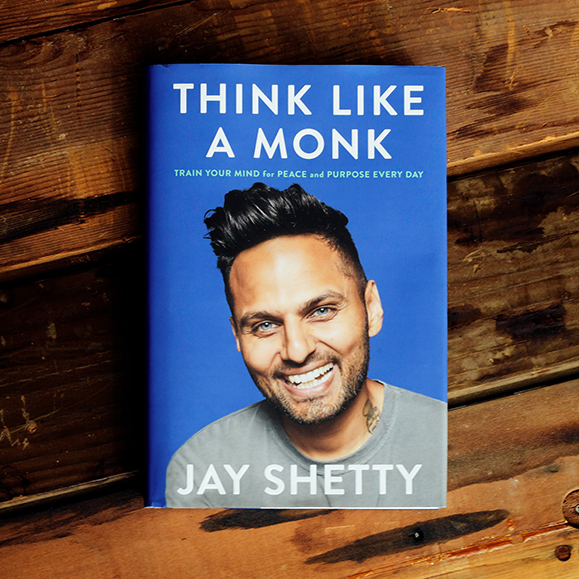
What was the main message or lesson of this book?
Think Like a Monk is a self help book that offers practical wisdom from Jay Shetty’s time spent as a monk. He shares his insights on how to find your purpose, how to overcome negative thoughts and ways to continue creating a more fulfilling lifestyle. The main message of this book is Shetty discussing the Buddhist Principle that everyone has their own Dharma. Dharma being purpose, duty or calling to life.
Did you find it inspiring and motivating?
What was truly motivating about this book is that Shetty guides individuals in developing their true passions and purposes in life. He encourages us to explore the link between our talents, passion and the impact we can make in society itself. Shetty discussed that no matter how disorganized we all may be, we all have plans. Shetty also points out that happiness and fulfillment come from one mastering the mind and connecting with the soul, not from objects or attainments. (Shetty,2020)
How do you implement what you learned from this book in my practice?
How I would utilize this book within my practice would be the explanation of what intention means. In chapter 4, Sherry discussed the 4 motivations that we have in life to move forward with the goals that we may have:
- Fear- Being driven by sickness, poverty, fear of hell or fear of death.
Jay discussed that fear is in sustainable in attaining your goals because when you pick fear you pick what you want to achieve hoping that it will bring you safety and security. We cant’ work to our best abilities with fear alone.
- Desire-Seeking personal gratification through success, wealth and pleasure.
He states that when we are motived by desire we are invited by personal gratification. In therapy a lot of clients are motivated by personal gratification. What I tend to see is achievements and acquisitions becoming the illusion of happiness and it does not always lead to internal happiness.
- Duty-Motivated by gratitude, responsibility and the desire to do the right thing.
- Love-Compelled by care for others and the urge to help them.
Duty and Love Shetty combines. He states that duty and love have more to offer when motivated by them. He mentions that Monks do not look for joy but focus on living a more meaningful life overall. I think this is an important topic in therapy. Sometimes we believe that the chase for external happiness is what overall makes us happy but many people have made to what we deem “success” and still have felt a level of unhappiness. In therapy is good to help people to understand that money and mansions are not the only wealth but that good character is wealth: good conduct is wealth; and (for those who are spiritual) spiritual wisdom is wealth. (Shetty, 2020)
What are some specific steps or strategies that you will use?
Chapter 10 is on Relationships. I think one of the topics I focus most on in sessions are relationships that people have with others whether family, friends or intimate partners.
Shetty identifies four types of trust. He discussed trusting someones competence because they have the right skills, you can trust someone’s nature of caring because they care about you, you can trust someone’s character because they have strong values and last you ca trust someones’ consistency because they show up when you need them.
Although there are several people in our lives, we don’t trust all of them in the same way. Jay recognized four stages of trust:
- Neutral trust recognizes that there are positive traits, but that doesn’t guarantee trust.
- Contractual trust is when we expect something from the other person and we know they are going to do it.
- Mutual trust is when we do something for another person and we expect they’d do the same for us.
- Pure trust is knowing that regardless of what happens, the other person is going to be there for you.
I believe that a lot of us have a hard time understanding the aspects of trust and what it can mean in certain relationships. These definitions of the differences in trust can be utilized therapeutically.
The last thing that I believes is a good strategy are the motivations that he discussed in romantic relationships. There are five motivations for a romantic connection:
Physical attraction: You like their appearance
Material: You like their possessions
Intellectual: You like the way they think
Emotional: You connect emotionally
Spiritual: You share values
By noticing your motivations, you see if you like someone as a whole or just a part. Long-term relationships are based on emotional and spiritual motivations. Even if you have the first three, you’re likely to have a weak, short-term relationship. Having a relationship should be about quality and not quantity.
Jay Shety’s, “Think Like a Monk,” truly helps one to embrace the core principles of mindfulness, gratitude, and selfless service. Through these we can cultivate a monk mindset, transforming our daily lives from one of confusion and distraction to one of clarity, purpose, and profound joy. Give it a read when you get a chance!
Shetty, Jay. Think Like a Monk: Train Your Mind for Peace and Purpose Every Day. First Simon & Schuster hardcover edition. Simon & Schuster, 2020.

